
What You Need to Know About Cording After Breast Cancer Surgery

Axillary web syndrome, or cording, is a condition that many breast cancer survivors experience after surgery.
Although it’s more commonly seen in breast cancer survivors, any cancer survivor who has lymph nodes removed from their axilla (armpit) can potentially develop cording. Keep reading to learn what cording is, how you can check if you have it, and how to treat it.
What is cording?
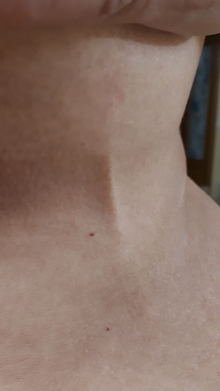
Axillary web syndrome involves the development of visible and palpable cords under the skin of the armpit. The cords can extend into the forearm, even as far as the hand and fingers, and sometimes down into the chest and ribcage. The cords are thought to develop due to damage to the lymphatic and venous systems.
The cords are tensed and pulled tight when you move your shoulder out to the side, called abduction, and straight forward and up, called flexion. It causes pain in the areas where the cording is located and limits mobility and function.Cording most often develops in the 2-8 weeks after surgery, but it can develop months or even years after the surgery. Cording can resolve on its own within 3-4 months after onset. However, many people will experience persistent cording and limitations beyond these couple of months. This indicates the importance of early diagnosis and treatment of this condition.
How to check if you have cording
It’s best to always work with a medical provider, especially a Certified Lymphedema Therapist, to get the proper diagnosis. However, here is a quick screen you can do yourself to see if you might have cording.
Stand in front of a mirror
Take your affected arm and raise it out to the side
Look and feel for any cording that is in the armpit, down the arm, or the trunk
Then, take your arm in front of you, and reach upwards
Again, Look and feel for any cording that is in the armpit, down the arm, or the trunk
If you SEE or FEEL a cord under the skin, contact your medical provider for assessment and see a cancer rehab physical therapist for a complete evaluation and treatment.
How is cording treated?
Once you are diagnosed with cording, it’s vital to get the best treatment. Cording is treated with multiple interventions, but the primary ones that will help resolve the cording and get your arm back to the full range of motion and function are:
Mobility and strengthening exercises
Hands-on manual therapy techniques
Manual lymphatic drainage (also known as lymphatic massage)
Compression, including compression bandaging or compression sleeves
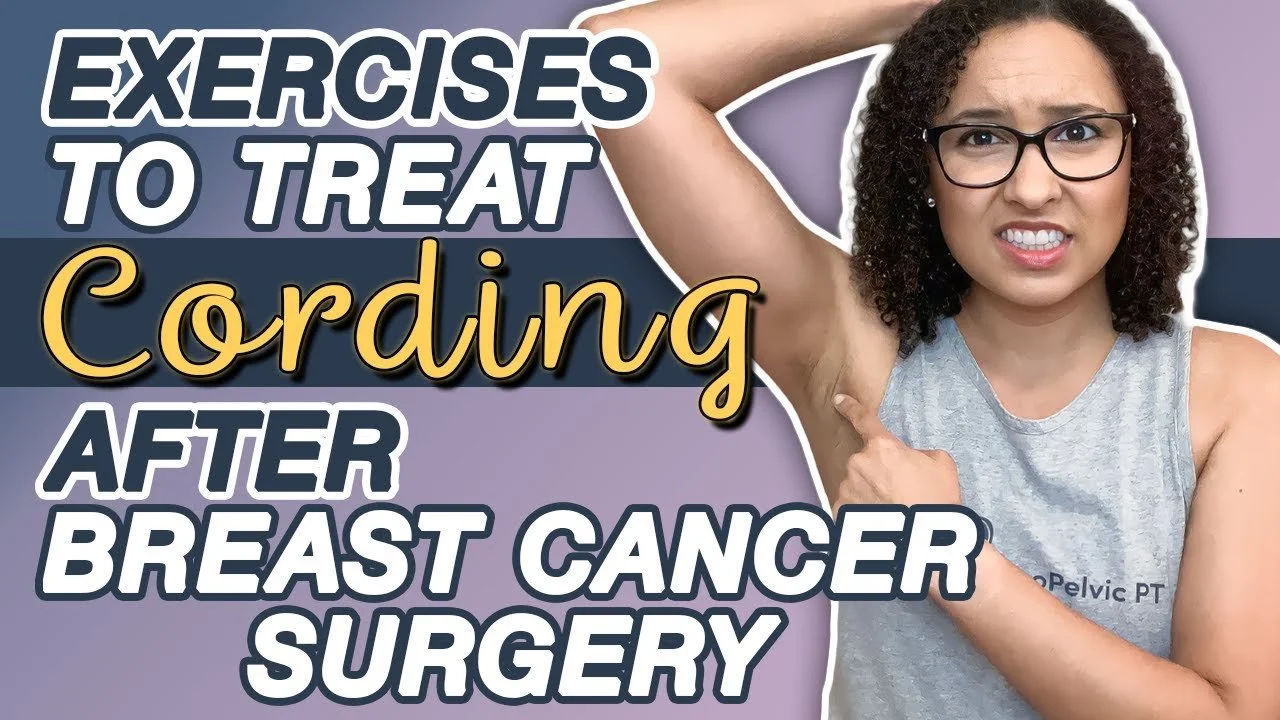
Treatment is typically gentle, and the goal is to reduce the cording while improving your range of motion and function. To learn the top exercises I recommend for people, watch my YouTube video where I guide you through 8 exercises to address your cording and get you back to doing what you love.
References:
Harris SR. Axillary Web Syndrome in Breast Cancer: A Prevalent But Under-Recognized Postoperative Complication. Breast Care (Basel). 2018 Apr;13(2):132-135. doi: 10.1159/000485023. Epub 2018 Feb 1. PMID: 29887791; PMCID: PMC5981636.
Koehler LA, Haddad TC, Hunter DW, Tuttle TM. Axillary web syndrome following breast cancer surgery: symptoms, complications, and management strategies. Breast Cancer (Dove Med Press). 2018 Dec 20;11:13-19. doi: 10.2147/BCTT.S146635. PMID: 30588087; PMCID: PMC6304256.
